Quick Answer:
- Dubai delivers 6% to 10%+ rental yields versus Australia’s 2.5% to 5.5% gross average.
- Dubai charges zero income tax, zero CGT, and zero annual property tax on investments.
- Australian investors face stamp duty, land tax, income tax, and CGT on domestic property.
- Dubai entry prices start from AUD 112,000 versus AUD 500,000 minimum in Australian cities.
- The AED is pegged to the USD, giving Brisbane investors stable currency conversion protection.
Brisbane investors are asking a harder question than ever before. Local property prices have surged 86% in five years. Rental yields have compressed below 5%. Tax obligations keep rising. The numbers that once justified domestic investment are under serious pressure.
This is where the Dubai vs Australia property investment comparison becomes genuinely urgent. Dubai now offers rental yields between 6% and 10%, zero income tax on rental returns, and entry prices significantly below what Brisbane demands. For investors who have always assumed domestic property is the safest path, the data is delivering a different message.
This guide compares both markets across every dimension Brisbane investors care about. You will find yield comparisons, full tax breakdowns, entry cost data, capital growth projections, and a clear framework for deciding how to allocate your capital in 2026.
Rental Yield Comparison
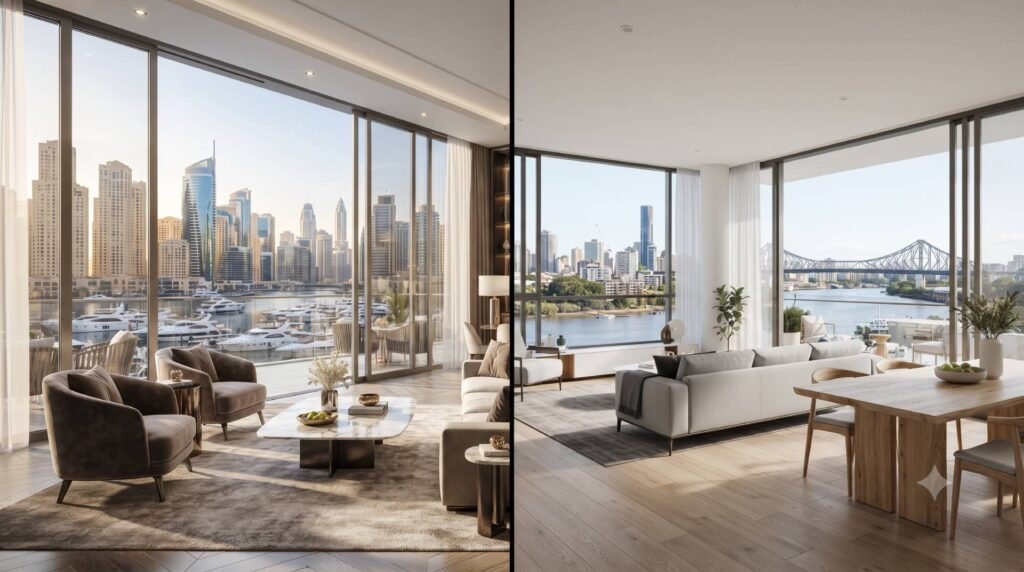
The yield gap between Dubai and Australia is the most decisive factor in the Dubai vs Australia property investment debate. It is not marginal. It is structural, persistent, and growing wider as Australian prices continue to rise without equivalent rent growth.
Brisbane investors chasing cash flow have no better starting point than this comparison.
Australia’s Yield Reality
In Australia, average gross yields for apartments in most cities sit around 3% to 4%. In premium suburbs, the yield can drop even lower, making it difficult to generate meaningful cash flow.
Australia’s rental yield breakdown by city in 2026:
| City | Apartment Yield | House Yield | Entry Price (AUD) |
| Brisbane | 4.5% to 5.5% | 3.5% to 4.2% | 1,130,000+ |
| Sydney | 2.5% to 3.5% | 2.2% to 3% | 1,400,000+ |
| Melbourne | 3% to 4% | 2.8% to 3.5% | 900,000+ |
| Perth | 4% to 5% | 3.5% to 4.5% | 750,000+ |
After deducting income tax, land tax, council rates, and management fees, Australian net yields often drop below 3%. This is the core problem driving Brisbane investors toward offshore alternatives in the Dubai vs Australia property investment comparison.
Dubai’s Yield Advantage
Rental yields in Dubai range from 8% to 13%, significantly higher than Sydney’s 2% to 4%, while the market also benefits from a tax-free environment with no stamp duty, capital gains tax, or rental taxes.
Dubai rental yield breakdown by community in 2026:
| Community | Gross Yield | Net Yield (Est.) | Entry Price (AED) |
| International City | 8% to 9% | 6.5% to 7.5% | 280,000 to 350,000 |
| Dubai Silicon Oasis | 7.5% to 9.3% | 6% to 7.5% | 300,000 to 500,000 |
| JVC | 7% to 9% | 5.5% to 7% | 450,000 to 750,000 |
| Business Bay | 6.5% to 8% | 5% to 6.5% | 900,000 to 1,300,000 |
| Dubai Marina | 6% to 8% | 5% to 6.5% | 1,000,000 to 1,800,000 |
Even after deducting service charges and management fees, net yields in Dubai typically range between 5.5% and 7%. In the Dubai vs Australia property investment comparison, Dubai delivers net returns that are nearly double what Brisbane offers before Australian tax reduces them further.
The Net Income Gap
Net income is the number that actually lands in your bank account. This is where the Dubai vs Australia property investment gap becomes most visible for Brisbane investors.
A direct net income comparison for a AUD 500,000 equivalent investment:
- Dubai (JVC one-bedroom): 7% gross, minus service charges and management = 5.5% to 6% net, minus ATO income tax at 32.5% marginal rate = approximately 3.7% to 4% after-tax net
- Brisbane (unit, equivalent value): 5% gross, minus management, maintenance, land tax, and income tax at 32.5% = approximately 2.5% to 3% after-tax net
Even after factoring in ATO obligations, Dubai vs Australia property investment still favours Dubai for net cash flow by a meaningful margin.
Rental income is only one measure of investment performance. A complete comparison also considers long-term capital growth, as property value appreciation plays a major role in building wealth over time in both Dubai and Australia.
Tax and Cost Structure

Tax is the single biggest differentiator in the Dubai vs Australia property investment comparison. The UAE’s zero-tax structure fundamentally changes the net return equation for Brisbane investors. Understanding the full cost stack on both sides removes any ambiguity.
Australian Tax Burden
Foreign investors in Australia face stamp duty, capital gains tax, income tax on rental revenue, and potential foreign buyer surcharges where applicable.
Full Australian property tax breakdown:
| Tax Type | Rate / Amount | Frequency |
| Stamp duty (QLD) | 3.5% to 5.75% of purchase price | One-time |
| Land tax (QLD) | Progressive from 0.5% on investment properties | Annual |
| Income tax on rent | 19% to 45% depending on marginal rate | Annual |
| Capital gains tax | Up to 45% (50% discount after 12 months) | On sale |
| Council rates | Varies by suburb | Quarterly |
These obligations collectively reduce net rental income by 30% to 45% for Brisbane investors. In the Dubai vs Australia property investment comparison, Australia’s tax stack is its most significant structural disadvantage.
Dubai’s Zero Tax Structure
Dubai charges zero income tax on rental income. Zero capital gains tax applies on sales. Zero annual property tax or land tax exists after purchase. The only government cost is the one-time 4% DLD registration fee.
Dubai’s complete transaction cost structure:
| Cost | Amount | Frequency |
| DLD transfer fee | 4% of purchase price | One-time |
| Trustee office fee | AED 4,000 plus VAT | One-time |
| Title deed issuance | AED 580 | One-time |
| Service charges | AED 12 to 35 per sqft | Annual |
| Property management | 5% to 8% of rent | Annual |
No recurring government taxes apply after registration. Australian tax residents must still declare Dubai rental income to the ATO, but the absence of UAE-side taxation keeps gross yield largely intact before ATO obligations reduce it.
FIRB and Foreign Buyer Rules
A critical point in the Dubai vs Australia property investment discussion is the regulatory treatment of each market’s foreign buyers.
- Dubai: Zero restrictions for Australians in 60+ freehold zones. No government approval needed. No foreign buyer surcharges apply. Australians can buy Dubai property with 100% freehold ownership immediately.
- Australia: Foreign buyers require FIRB approval for existing properties. Foreign buyer duty surcharges of 7% to 8% apply in Queensland on top of standard stamp duty. These charges significantly increase total entry costs for non-residents.
The regulatory landscape firmly favours Dubai in the Dubai vs Australia property investment comparison for international investor accessibility.
Taxes and ownership costs have a major impact on overall investment returns, but they are only part of the decision. Comparing long-term market performance, demand drivers, and future growth prospects provides a more complete picture of how Dubai and Australia differ as investment destinations.
Capital Growth Comparison
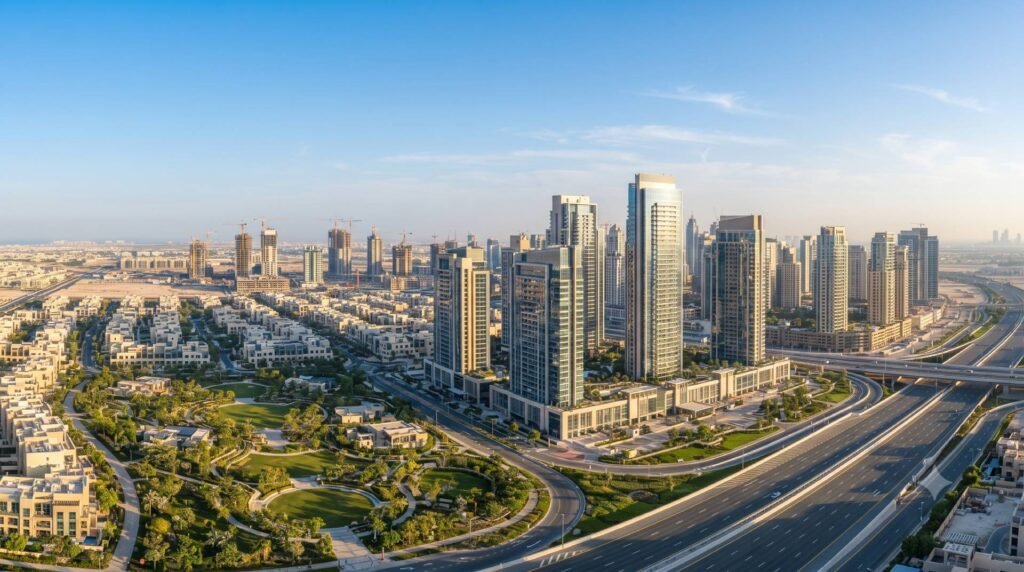
Yield tells half the story. Capital growth tells the other half. Brisbane investors evaluating Dubai vs Australia property investment need a complete picture of how each market has performed and where each is heading in 2026.
Australia’s Growth Track Record
Australia’s residential market has delivered consistent long-term capital appreciation. Brisbane specifically surged 86% over five years to 2025. However, that growth cycle is maturing.
Australian capital growth outlook for 2026:
- Brisbane: Forecast 5% to 8% growth in 2026 after the surge cycle
- Sydney: 3% to 5% expected as affordability constrains demand
- Melbourne: 2% to 4% as population growth continues but confidence wavers
- Overall: Australian property remains a proven long-term growth asset
The challenge for Brisbane investors is that high entry prices now mean even strong capital growth delivers smaller percentage returns on equity deployed. In the Dubai vs Australia property investment comparison, Australia’s growth story is real but increasingly priced in.
Dubai’s Growth Performance
Dubai properties have recorded annual capital growth of between 10% and 20% in recent years, with Knight Frank confirming 19.1% capital growth in 2024.
Dubai capital growth metrics by community:
| Community | Annual Growth (2025) | 2026 Forecast | Key Driver |
| Dubai Hills Estate (villas) | 17% to 18% | 17.7% (ValuStrat) | Master plan, family demand |
| Business Bay | 12% to 15% | 8% to 12% | Corporate demand, infrastructure |
| JVC | 10% to 13% | 6% to 10% | High volume, tenant demand |
| Dubai South | 10% to 15% | 8% to 12% | Airport expansion |
| Palm Jumeirah | 15% to 20% | 8% to 12% | Luxury scarcity |
Price growth reached about 15% year on year through 2025, with 2026 projections indicating moderation to 5% to 8% annual growth as the market stabilises. This moderation makes Dubai vs Australia property investment more comparable on growth while Dubai maintains its decisive yield advantage.
Currency Diversification
The UAE Dirham is pegged to the US dollar. If the Australian dollar weakens against the USD, the value of the Dubai asset effectively increases when converted back to Australian currency.
- AUD weakness against USD directly increases the AUD value of Dubai holdings
- AED rental income grows in AUD terms whenever the dollar falls
- Portfolio diversification across AUD and USD-pegged currencies reduces concentration risk
- Brisbane investors gain a natural inflation and currency hedge through Dubai property
This currency peg is a hidden advantage in the Dubai vs Australia property investment comparison that most Brisbane investors overlook.
Strong investment decisions balance both rental income and long-term capital appreciation. With growth prospects compared, the next step is evaluating the practical factors such as financing, ownership costs, and market accessibility that influence the overall investment experience in Dubai and Australia.
Entry Costs and Accessibility
How much capital do you actually need? The entry cost comparison in the Dubai vs Australia property investment analysis often surprises Brisbane buyers who assume Dubai is expensive. The reality is the opposite at most budget levels.
Australian Entry Costs
A competitive Brisbane investment property requires:
- Median house price above AUD 1,130,000
- Stamp duty on AUD 1,130,000 purchase: approximately AUD 42,000
- Deposit (20% for investment mortgage): AUD 226,000
- Total upfront capital required: approximately AUD 268,000 minimum
This excludes loan approval costs, inspections, legal fees, and initial maintenance. Australian entry costs in the Dubai vs Australia property investment comparison create the highest barrier of any market considered.
Dubai Entry Costs
Dubai off-plan apartments start from approximately AED 280,000 (AUD 112,000). With a 10% booking deposit, the initial outlay can be as low as AUD 11,200. Interest-free payment plans spread the balance across two to four years.
Dubai entry cost breakdown at different budget levels:
| Budget Level | Community Options | Initial Deposit | Gross Yield |
| AUD 112,000 to 200,000 | International City, DSO, JVC | AUD 11,200 to 20,000 | 7.5% to 9.5% |
| AUD 200,000 to 400,000 | JVC, Arjan, Dubai South | AUD 20,000 to 40,000 | 6.5% to 8.5% |
| AUD 400,000 to 800,000 | Business Bay, Marina, Creek Harbour | AUD 40,000 to 80,000 | 6% to 8% |
| AUD 800,000 plus | Dubai Hills, Downtown, Palm | AUD 80,000 plus | 5% to 7% |
In the Dubai vs Australia property investment comparison, many investors begin around AED 500,000 to AED 1 million for studios or compact apartments, with higher budgets for prime areas, villas, and Golden Visa strategies.
Transaction Speed
The buying process in each market differs significantly in time and complexity:
- Dubai: Transactions complete in 7 to 14 days for ready properties. Off-plan reservation in 24 to 48 hours. No government pre-approval needed.
- Australia: Settlement typically takes 30 to 60 days. FIRB approval adds 30 days for foreign buyers. Stamp duty assessment and payment required upfront.
Speed of access is a meaningful practical advantage in the Dubai vs Australia property investment comparison, particularly for Brisbane investors comparing multiple opportunities simultaneously.
Lower entry costs and faster transactions make Dubai more accessible for many Brisbane investors, but affordability is only one part of the decision. Comparing financing options, ownership flexibility, and long-term investment objectives will help determine which market is the better fit for your portfolio.
Golden Visa vs Australian Visa

One of the most unique features of the Dubai vs Australia property investment comparison is the residency dimension. Dubai property investment can unlock long-term UAE residency. Australian property investment offers no such benefit.
Dubai Golden Visa Benefits
Purchasing AED 2 million in Dubai property (approximately AUD 800,000) qualifies for a 10-year Golden Visa. April 2026 reforms simplified the process further.
Key Golden Visa benefits for Brisbane investors:
- 10-year renewable UAE residency for investor and family
- Sponsor spouse, children, and up to three domestic staff
- No minimum stay requirement in the UAE
- UAE banking and business setup access without a local sponsor
- Bank guarantees now accepted instead of full upfront cash
The Golden Visa transforms the Dubai vs Australia property investment comparison for Brisbane investors considering lifestyle diversification alongside financial returns.
SMSF Investment Options
Both markets allow SMSF investment under specific conditions:
- Dubai: ATO permits SMSF investment in overseas property under the sole purpose test. Independent financial advice is mandatory. FIRB approval is not required for outbound investment.
- Australia: SMSF investment in domestic residential property is allowed but cannot be purchased from related parties or used personally.
SMSF investors exploring the Dubai vs Australia property investment option should engage a Brisbane accountant with international SMSF experience before proceeding. More guidance on property investment from Australia is available in our dedicated investor guide.
Risk Factors on Both Sides
Every investment carries risk. The Dubai vs Australia property investment comparison requires an honest assessment of what can go wrong on both sides. Brisbane investors who understand the risks make better allocation decisions.
Australian Market Risks
Sydney remains Australia’s largest and most internationally recognised property market. However, rising property prices, higher borrowing costs, and lower rental yields are causing many Australians to reassess whether Sydney still delivers the best overall return in 2026.
Key risks in Australian property:
- Rising interest rates increasing mortgage serviceability pressure
- Compressed yields creating negative cash flow on highly leveraged assets
- State government land tax changes affecting net returns on investment portfolios
- Affordability ceiling limiting future capital growth potential in major cities
- Regulatory changes around negative gearing reducing investor tax incentives
Every property market carries risks that can affect returns over time. Weighing these challenges alongside the potential opportunities helps Brisbane investors make more informed decisions and build a more resilient investment strategy.
Dubai Market Risks
Dubai has historically been volatile. Corrections in 2008 to 2009 and 2014 to 2016 were significant. The current cycle has been extended. Investors should factor this cycle risk into long-term planning.
Key risks in Dubai investment property:
- Developer delivery delays on off-plan projects of 6 to 18 months
- Supply pipeline of approximately 100,000 units forecast for 2026 delivery
- AED to AUD currency movements when converting rental income
- Service charge increases reducing net yield over time
- Geopolitical regional uncertainty affecting short-term buyer sentiment
Both markets carry risk. The Dubai vs Australia property investment comparison shows different risk profiles rather than a clearly safer option. Brisbane investors should diversify across both markets rather than treating this as a binary choice.
Make Your Move From Brisbane
The Dubai vs Australia property investment comparison points clearly to a diversified approach. Australia delivers long-term stability and institutional depth. Dubai delivers superior yield, zero tax efficiency, lower entry costs, and the Golden Visa pathway. For Brisbane investors, the question is no longer which market is better. The question is how to allocate capital intelligently across both.
The Dubai Property Expo Brisbane 2026 brings licensed developers including Emaar, DAMAC, Binghatti, Ellington, and Danube directly to Queensland. Compare over 100 Dubai investment property options in a single venue, with private consultations matched to your AUD budget and yield targets. Every exhibiting developer holds a verified DLD licence, giving Brisbane investors a fully vetted, risk-reduced starting point. You can also stay updated on the latest developments and expo announcements through the Brisbane investor blog.
Register now at dubaipropertyexpobrisbane.com.au and take the first step toward a smarter, internationally diversified property portfolio built for Brisbane investors in 2026.
Frequently Asked Questions
Is Dubai vs Australia property investment better for Brisbane buyers in 2026?
It depends on your investment goals. Dubai generally offers higher rental yields, lower entry prices, and tax advantages, while Australia provides greater long-term stability and consistent capital growth. Many Brisbane investors benefit from holding assets in both markets.
Do I pay Australian tax on Dubai rental income?
Yes. Australian tax residents must declare Dubai rental income to the ATO, although Dubai does not tax rental income locally. Eligible expenses and depreciation can be claimed, so professional tax advice is recommended.
How do Dubai and Australia compare on capital growth?
Australia has a stronger long-term track record for steady capital growth, while Dubai has delivered higher growth during recent market cycles. Many investors choose both markets to balance stability with higher return potential.
Can I use my SMSF to invest in Dubai property?
Yes. An SMSF can invest in Dubai property if it complies with ATO rules, including the sole purpose test and other superannuation requirements. Professional legal and financial advice is strongly recommended before proceeding.
What is the biggest advantage of Dubai over Australian property for Brisbane investors?
Dubai’s biggest advantages are higher rental yields, lower entry costs, and interest-free developer payment plans. Eligible investors may also qualify for the UAE Golden Visa, providing an additional long-term benefit.