Quick Answer:
- A typical Dubai short-term rental generates AED 172,000 ($47,000) annually with a 73% occupancy rate.
- Dubai short-term rental income carries zero UAE income tax at the source for individual investors.
- DET holiday home licensing costs AED 1,500 and is mandatory before listing any property.
- Short-term rentals deliver 25% to 50% higher net yields than long-term leases in premium areas.
- Dubai Marina, Downtown Dubai, and Palm Jumeirah are the strongest short-term rental income zones.
Brisbane property investors are earning 4% to 5% gross on local units. After income tax, land tax, and management costs, many net below 3%. It is not a cash flow strategy. It is a waiting game for capital growth that keeps getting more expensive to play.
Dubai short-term rental income changes this equation completely. Furnished apartments in Dubai Marina, Downtown, and Palm Jumeirah deliver 8% to 12% gross yields through short-term leasing. Zero income tax applies at the UAE end. And international visitor numbers exceeded 21 million in 2025, creating a deep, year-round guest market that Brisbane simply cannot replicate.
This guide covers everything Brisbane investors need to know about Dubai short-term rental income. You will learn the real market data, the best areas, the true costs, licensing requirements, and how short-term returns compare to long-term leasing in 2026.
Why Dubai STR Beats Long-Term
The core argument for Dubai short-term rental income starts with a direct comparison to long-term leasing. Short-term listings charge nightly rates that far exceed the per-night equivalent of an annual lease. That gap, combined with Dubai’s zero-tax environment, creates the income advantage that attracts Brisbane investors.
Income Gap Explained
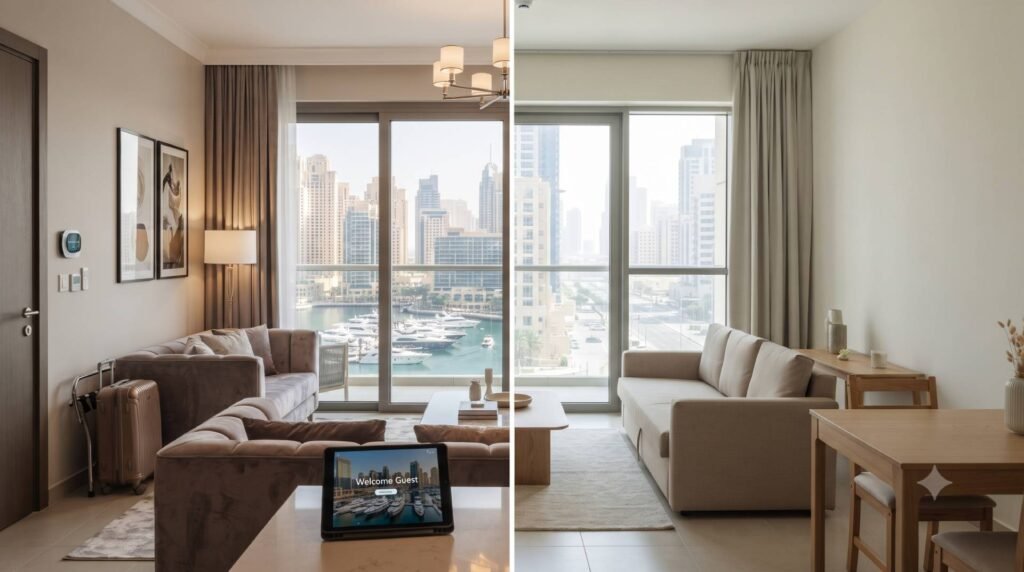
Short-term rentals consistently deliver 40% to 90% higher gross revenue than long-term leases on a gross basis. The math works because nightly rates significantly outpace annualised lease rates in Dubai’s high-demand areas.
A practical income comparison for a one-bedroom apartment in Dubai Marina:
| Rental Model | Annual Income (AED) | Annual Income (AUD) | Gross Yield |
| Long-term lease (annual) | 90,000 to 110,000 | 36,000 to 44,000 | 6% to 7.5% |
| Short-term rental (STR) | 130,000 to 175,000 | 52,000 to 70,000 | 8.5% to 12% |
| STR premium over long-term | 40% to 59% higher | Significant AUD gain | Clear advantage |
This income premium is what drives Brisbane investors toward Dubai short-term rental income as a strategy. The nightly rate flexibility allows pricing to respond to peak demand in a way that fixed annual leases cannot.
Zero Tax Advantage
Dubai charges zero personal income tax on short-term rental income for individual investors. No GST on rental income. No council rates. No land tax between stays. This tax profile is unique among global short-term rental markets.
Brisbane investors running a comparable Airbnb strategy in Australia face:
- Income tax at marginal rates on all rental revenue
- GST registration required if revenue exceeds AUD 75,000 annually
- Council rates applying continuously through the year
- State land tax on investment properties regardless of occupancy
The absence of UAE-side taxation keeps Dubai short-term rental income dramatically more efficient than Australian short-term rental strategies. Brisbane investors must still declare Dubai income to the ATO, but the zero-tax start point makes a material difference to net returns.
Tourism Demand Drivers
Dubai’s visitor numbers underpin the entire Dubai short-term rental income thesis. The market does not depend on a single source of demand. It draws from tourism, business travel, remote workers, and event-driven spikes simultaneously.
Key demand drivers for Dubai STR in 2026:
- Dubai Department of Economy and Tourism recorded 21 million international visitors in 2025
- Major events including GITEX, Dubai Shopping Festival, and Art Dubai drive seasonal spikes
- Virtual Work Residence Visa brings digital nomads seeking furnished monthly stays
- Over 4 million residents create a staycation and short-stay market year-round
- New airline routes and expanded Al Maktoum Airport increase arrival volumes
This multi-stream demand structure means Dubai short-term rental income stays relatively resilient across seasons. Even during softer summer months, remote workers and corporate travelers fill demand gaps that pure tourism markets cannot sustain.
Dubai STR Market Data
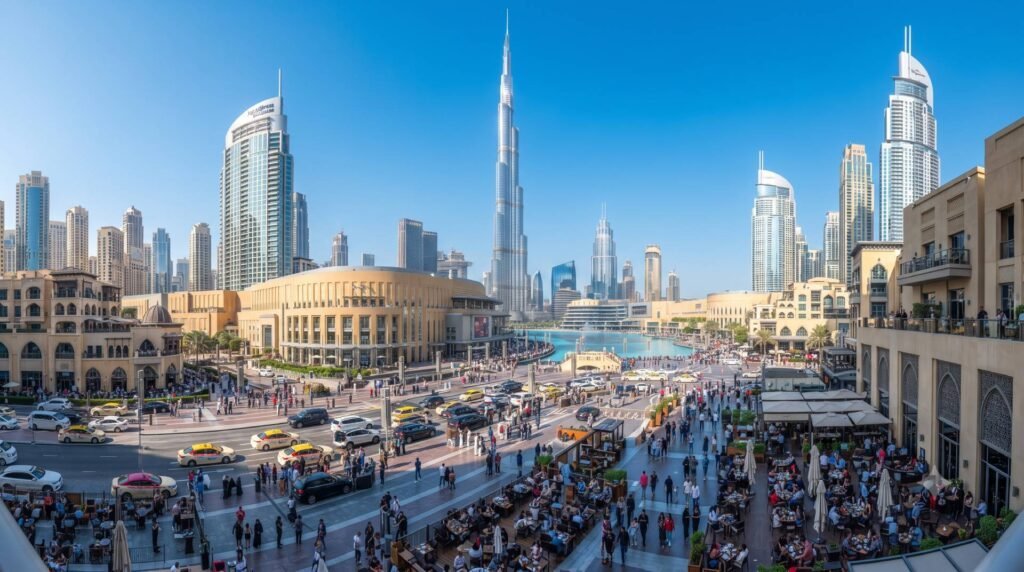
Numbers matter more than narrative in the Dubai short-term rental income discussion. Brisbane investors need verified market data before committing capital. The 2026 data from multiple independent analytics platforms paints a consistent and compelling picture.
Key 2026 Statistics
Dubai short-term rentals on Airbnb and Vrbo average 60% occupancy, a $228 daily rate, and $18,894 in monthly revenue. These citywide averages include underperforming and newly listed properties that bring the numbers down.
Top-line Dubai STR market data for 2026:
| Metric | Citywide Average | Premium Areas | Source |
| Active STR listings | 47,626 | N/A | AirDNA June 2026 |
| Average occupancy | 60% to 73% | 75% to 85% | AirDNA / Airbtics |
| Average daily rate (ADR) | AED 638 to 860 | AED 1,000+ | Airbtics / Research |
| Annual revenue (median) | AED 172,000 | AED 200,000 to 300,000 | Airbtics |
| Gross yield (Dubai Marina) | 8% to 12% | Up to 14%+ | Multiple sources |
Dubai ranks in the top 15% for short-term rental yield in the Middle East and North Africa region. This ranking confirms that Dubai short-term rental income performance is not just strong in a global context. It leads its entire regional peer group.
Occupancy Rate Reality
Not all occupancy data tells the same story. Headline figures often average across all listings, including inactive or poorly managed properties. Brisbane investors should target realistic occupancy projections for active, well-positioned assets.
Occupancy factors that Brisbane investors can control:
- Professional photography increases booking conversion by 20% to 30%
- Response rate above 90% improves platform ranking visibility
- Flexible check-in options capture last-minute bookings
- Competitive pricing during shoulder seasons maintains base occupancy
- Premium furnishing and fast Wi-Fi attract business travellers and remote workers
Targeting 60% to 70% annual occupancy is a realistic and conservative planning assumption for active, well-managed Dubai short-term rental income properties in mid-tier communities.
ADR by Season
Dubai short-term rental income is not flat across the year. Seasonality creates meaningful pricing opportunities that long-term leases cannot capture. Brisbane investors who understand the seasonal pattern can plan pricing strategies months in advance.
Dubai STR seasonal performance guide:
| Season | Months | Occupancy | ADR Premium | Key Drivers |
| Peak | Nov to Feb | 75% to 90% | 30% to 50% above average | Tourism, events, perfect weather |
| Shoulder | Mar to Apr, Oct | 60% to 75% | Average rates | Spring travel, moderate weather |
| Low | May to Sep (summer) | 40% to 55% | 10% to 20% below average | Heat, reduced tourism |
| Event spike | GITEX, DSF, Art Dubai | 85% to 95% | 50% to 100% above average | Event-driven demand |
A hybrid rental strategy using Airbnb during peak winter months and short-term leases in summer can optimise occupancy rates and maximise annual ROI. This flexibility is one of the strongest structural advantages of Dubai short-term rental income over fixed annual leases.
Best Areas for STR
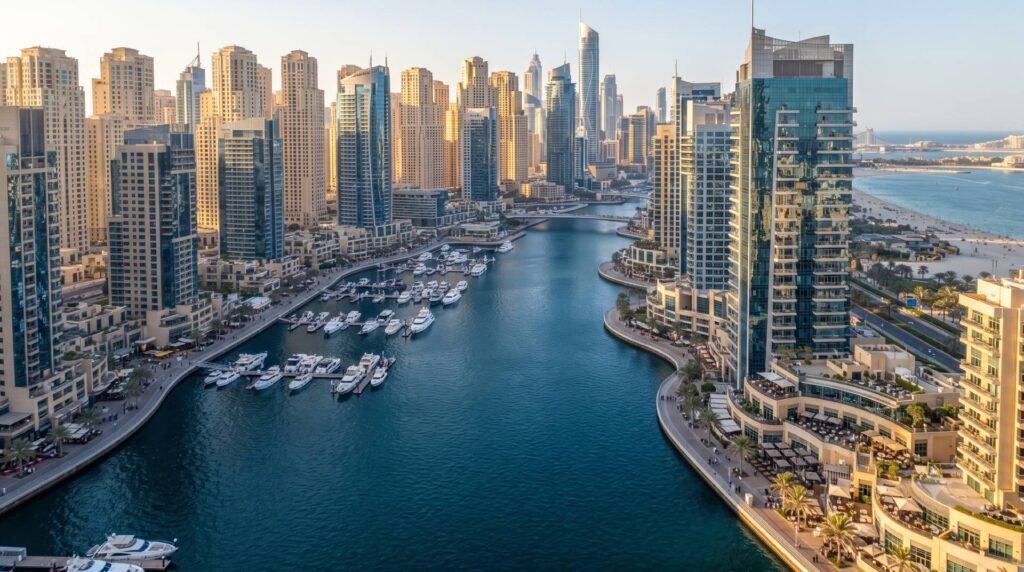
Location determines the ceiling on Dubai short-term rental income. Premium tourist and business areas command significantly higher nightly rates and occupancy than suburban communities. Brisbane investors should prioritise proximity to attractions, transit, and the waterfront.
Dubai Marina Performance
Dubai Marina consistently ranks as one of Dubai’s top-performing zones for Dubai short-term rental income. Waterfront access, walkable retail, and proximity to JBR Beach create year-round guest appeal.
Dubai Marina STR performance metrics:
- Gross STR yields: 8% to 12% for well-managed one-bedroom apartments
- Average nightly rates: AED 700 to AED 1,200 during peak season
- Occupancy: 70% to 85% for actively managed listings
- Target guest profile: couples, leisure tourists, short-stay business visitors
- Key demand driver: proximity to The Walk, Marina Mall, and Dubai Eye
Brisbane investors buying in Dubai Marina through Dubai investment properties for Brisbane buyers gain access to one of the city’s most resilient short-term rental demand pools.
Downtown and Palm
Downtown Dubai and Palm Jumeirah sit at the premium end of Dubai short-term rental income. Higher purchase prices reduce gross yield percentages, but absolute income is strongest here. Iconic positioning commands premium nightly rates that mid-market areas cannot match.
Downtown Dubai and Palm Jumeirah STR highlights:
- Downtown nightly rates: AED 800 to AED 2,000 for one- and two-bedroom units
- Palm Jumeirah villa STR income: AED 300,000 to AED 600,000 annually for four-bedroom frond villas
- Downtown annual gross revenue: AED 180,000 to AED 280,000 for one-bedrooms
- Guest profile: high-net-worth travellers, couples, luxury short breaks
- Proximity to Burj Khalifa and Dubai Mall sustains demand throughout the year
Short-term rental income in Downtown and Palm suits Brisbane investors with larger budgets who prioritise absolute income over yield percentage.
JVC and Business Bay
JVC and Business Bay offer a different Dubai short-term rental income profile. Higher percentage yields come from lower purchase prices combined with strong corporate and professional guest demand.
JVC and Business Bay STR comparison:
- JVC gross STR yields: 8.5% to 11% for well-managed studios and one-beds
- Business Bay gross STR yields: 7.5% to 10% with strong corporate travel demand
- Business Bay one-bed nightly rates: AED 550 to AED 900
- JVC studio nightly rates: AED 350 to AED 600 with high occupancy volume
- Both areas attract remote workers, digital nomads, and short-assignment professionals
For Brisbane investors comparing rental properties in Dubai, JVC and Business Bay offer the best entry-level access to Dubai short-term rental income with lower capital requirements.
What STR Really Costs

Gross yield is only the starting point for Dubai short-term rental income calculations. Multiple cost layers sit between gross revenue and net income. Brisbane investors must model every cost category before setting return expectations.
DET Licensing Requirements
All short-term rental properties in Dubai must hold a valid Department of Economy and Tourism holiday home licence. Operating without a licence carries fines between AED 5,000 and AED 50,000. There are no exceptions.
DET licensing breakdown for Brisbane investors:
- Registration fee: AED 1,500 per property annually
- Individual property permit: required for each rental unit under the licence
- Up to 8 properties: covered under a single individual operator licence
- More than 8 properties: commercial trade licence required
- Compliance requirements: regular property inspections, safety standards, guest registration
The licensing process is straightforward and well documented. Brisbane investors managing Dubai short-term rental income through a professional management company typically have licensing handled on their behalf.
Management Fee Breakdown
Professional management is not optional for Brisbane investors managing Dubai short-term rental income from 16,000 kilometres away. Full-service operators handle everything from guest communication to maintenance.
Short-term rental management cost structure:
| Service | Cost | Basis |
| Full management fee | 15% to 25% of gross revenue | Monthly |
| Platform fees (Airbnb/Booking) | 15% to 20% of booking value | Per booking |
| DEWA utilities | AED 8,000 to 15,000 annually | Annual |
| Housekeeping per turnover | AED 150 to 300 | Per stay |
| Initial furnishing | AED 20,000 to 30,000 | One-time |
| Maintenance reserve | 1% to 2% of property value | Annual |
Total operating costs typically consume 40% to 55% of gross Dubai short-term rental income. After all deductions, net yields sit between 5.5% and 8% for well-managed assets in premium areas.
Operating Cost Summary
Net income projections for a one-bedroom apartment generating AED 150,000 gross Dubai short-term rental income annually:
- Gross STR revenue: AED 150,000
- Management fees (20%): minus AED 30,000
- Platform fees absorbed in management: included above
- DEWA utilities: minus AED 12,000
- Housekeeping and turnover: minus AED 15,000
- Maintenance reserve: minus AED 8,000
- DET licence: minus AED 1,500
- Service charges: minus AED 14,000
- Net annual income: approximately AED 69,500 (AUD 27,800)
On an AED 1.2 million purchase price, this delivers approximately 5.8% net yield. That still outperforms Brisbane’s sub-3.5% net yield on comparable assets after Australian tax obligations. Australians buying property in Dubai can access these returns with full freehold ownership rights.
STR vs Long-Term Comparison
Brisbane investors consistently ask whether Dubai short-term rental income outperforms long-term leasing once all costs are factored in. The answer depends on location, management quality, and strategy. But the data provides a clear framework.
Gross Income Gap
Short-term rentals can deliver 25% to 50% higher net yields compared to traditional long-term leases, especially in premium areas like Dubai Marina and Business Bay.
Gross income comparison for a one-bedroom apartment in Business Bay:
- Long-term annual lease: AED 95,000 to AED 110,000 (fixed income, tenant pays utilities)
- Short-term rental (65% occupancy, AED 700 ADR): approximately AED 166,000 gross
- Income premium: AED 56,000 to AED 71,000 more annually through STR
- Risk trade-off: STR income fluctuates; long-term income is fixed
The gross income advantage of Dubai short-term rental income is real and material. The question is whether that premium survives the higher operating cost structure of STR management.
Net Yield After Costs
After all operating costs, the net advantage of Dubai short-term rental income over long-term leasing narrows. Some investors on Reddit confirm the realistic premium can be as low as 2% to 3% once all costs are deducted. Others achieve 5% or more with optimal management.
Realistic net yield comparison:
- Long-term lease (passive): 6% to 7.5% gross, tenant pays utilities, minimal management effort, predictable income
- STR (active): 8% to 12% gross, owner pays utilities, 15% to 25% management fee, higher net of 5.5% to 8% for premium areas
For Brisbane investors who want truly passive Dubai short-term rental income, long-term leasing remains the lower-effort alternative. For those who want maximum income and accept higher operational complexity, STR in premium areas delivers materially stronger cash flow.
Best Strategy Choice
The most successful Brisbane investors combine both strategies across their Dubai portfolios. This hybrid approach captures the income advantages of STR during peak demand without sacrificing the stability of long-term leasing.
A practical hybrid approach to Dubai short-term rental income:
- Run STR from November through April during peak tourism season
- Switch to short-term corporate leases from May through October during summer
- Maintain one long-term leased asset for stable baseline income
- Layer a STR asset in a premium area for income upside during peak months
- Consider the Golden Visa pathway at AED 2 million to add residency value
This strategy captures most of the Dubai short-term rental income premium while reducing the volatility risk that deters some Brisbane investors from committing to a pure STR model
Start Earning From Dubai STR
Dubai short-term rental income gives Brisbane investors access to 8% to 12% gross yields, AED 172,000 median annual revenue, and a zero-tax operating environment that no Australian city can match. The regulatory framework is clear, the demand is structural, and the income advantage over long-term leasing is real for well-positioned assets in premium communities. With 21 million visitors in 2025 and a city growing by over 200,000 residents annually, the demand foundation for Dubai short-term rental income is as strong as it has ever been.
The Dubai Property Expo Brisbane 2026 brings licensed developers and STR-optimised projects directly to Queensland. Compare furnished apartments, discuss STR income projections, and meet property management specialists who handle licensing, guest management, and DET compliance on your behalf. Private consultations are available to match your AUD budget with the right area, property type, and rental strategy for maximum Dubai short-term rental income. You can also explore the latest project updates and STR guides on the Brisbane investor blog.
Register now at dubaipropertyexpobrisbane.com.au and take the first step toward high-yield, tax-efficient short-term rental income from Dubai.
Frequently Asked Questions
How much can Brisbane investors earn from Dubai short-term rental income?
Well-managed Dubai short-term rentals can generate high annual income, with premium locations often delivering higher returns than long-term leases. After expenses, net yields typically range from 5.5% to 8%, although Australian tax residents must declare this income to the ATO.
Is Dubai short-term rental income legal for foreign investors?
Yes. Foreign investors, including Australians, can legally operate short-term rentals in Dubai by obtaining the required Department of Economy and Tourism (DET) permit or using a licensed property management company to handle compliance.
Which Dubai area gives the best short-term rental income returns?
Dubai Marina, Downtown Dubai, and Palm Jumeirah generate the highest rental income, while JVC and Business Bay often deliver the strongest percentage yields due to lower purchase prices. The best choice depends on your budget and investment goals.
How does Dubai STR income compare to long-term rental?
Short-term rentals can produce 25% to 50% higher net yields than long-term leases, but they also involve higher management and operating costs. Long-term rentals provide more stable income, while STRs offer greater earning potential with active management.
What is the occupancy rate for Dubai short-term rentals?
Dubai short-term rentals typically average around 60% occupancy, with well-managed properties in prime areas achieving 70% to 85% annually. Occupancy peaks during the winter tourism season and softens during the summer months.